
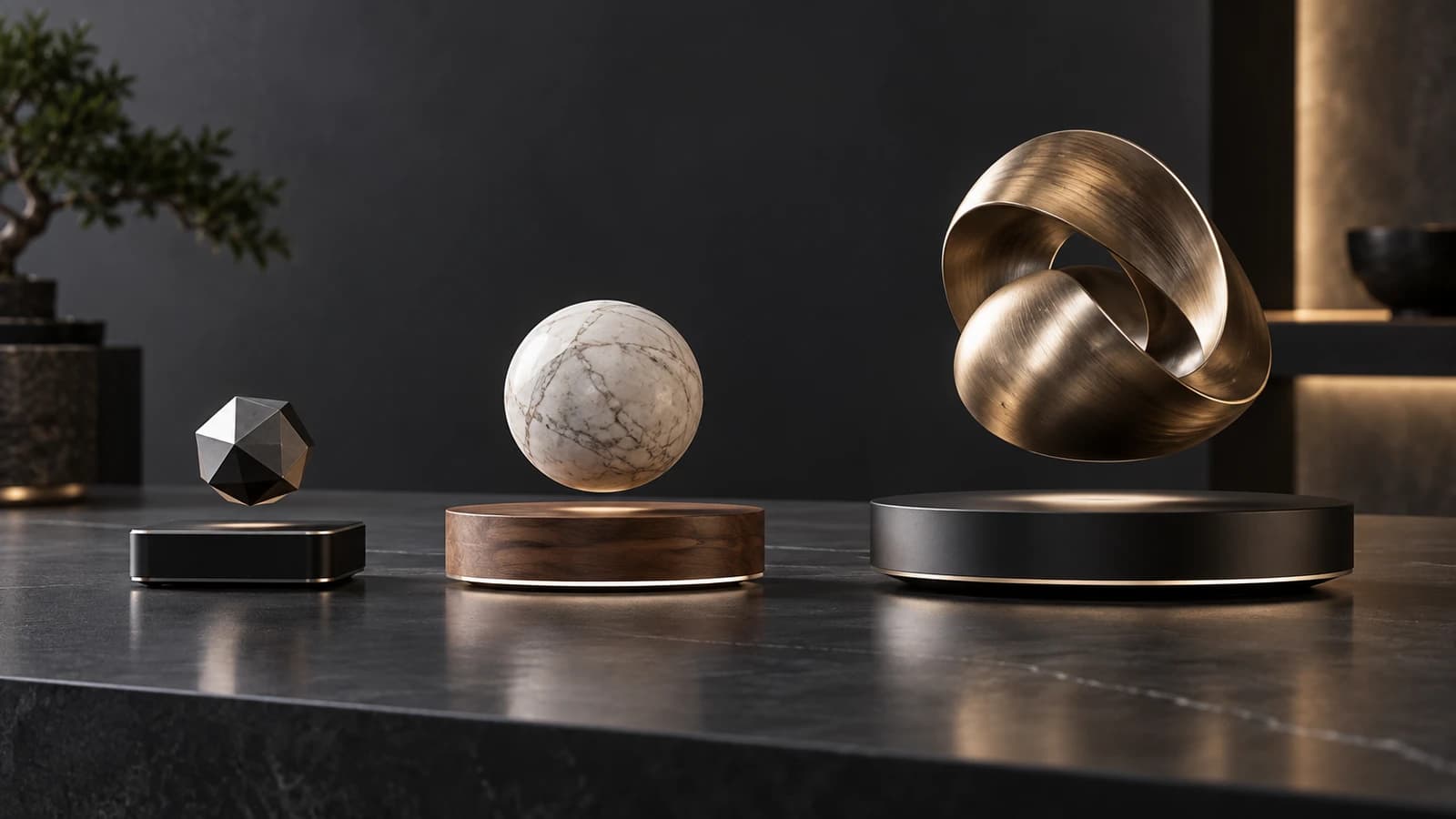
Direct Answer
Choose a magnetic levitation display stand by matching it to the complete floating object, not by choosing the base that looks strongest. Start with total weight, dimensions, center of gravity, and the magnetic assembly inside the object. Then check the intended air gap, rotation behavior, operating time, power standard, noise level, surface finish, and the environment where the display will be used.
For a ready-made product, buy the object and base as a tested set. For a custom product, ask the supplier to confirm compatibility using drawings, a sample, or a realistic prototype. A good stand is one that gives stable presentation with practical operating margin, not one advertised with the largest maximum load.
Start With the Object, Not the Base
The object defines the engineering problem. Record its final weight, height, width, depth, material, intended orientation, and any heavy parts inside. A tall object may need a different magnetic position than a compact object with the same weight. If the object includes lighting, a battery, or moving parts, those items must be included in the payload and balance review.
Also decide what people should see. If every side matters, slow rotation may be useful. If the front must remain facing the viewer, uncontrolled rotation may be a disadvantage. A stand selected before these decisions can force compromises later, so begin with the presentation goal and the real object data.
Match Payload With Operating Margin
Payload specifications should be treated as a range, not a target to push to the edge. A base may briefly lift an object near its maximum while still being too sensitive for reliable daily use. Material variation, assembly tolerance, small impacts, and changes to packaging or finish can all affect the final floating mass.
Ask for a recommended operating range for your object shape, not only the highest demonstrated number. For commercial use, sample the complete assembly and observe how easily it centers, recovers from small movement, and behaves over the intended operating period. Stable margin is more valuable than an impressive but fragile limit.
Choose the Right Size and Visual Proportion
The base should look visually related to the object. A very wide base under a tiny object can make the system feel heavy, while a narrow base under a large object may look uncertain even if it technically works. Viewing distance also changes the decision. A desk product can use a compact base; a retail counter or exhibition display may need more visual scale and a larger safety zone.
Measure the full footprint, including cable clearance and any protective boundary. Consider whether the base will be recessed into furniture, placed on a pedestal, or left fully visible. If the enclosure is custom, engineering clearances, ventilation, and service access must remain intact beneath the desired exterior.
Consider Rotation, Light, Noise, and Power
Presentation features should be specified rather than assumed. Some floating objects rotate after a gentle push, while others are designed for a more controlled motion. Integrated lighting may improve the effect but changes power, heat, wiring, and finish requirements. Quiet performance matters in a bedroom, boutique, hotel lounge, or museum more than it might on a busy trade-show floor.
Confirm the supplied adapter, destination voltage, cable route, switch location, and what happens after a power interruption. For a store rollout, setup should be repeatable by normal staff. A visually impressive sample is not enough if every unit requires specialist adjustment each morning.
Standard Stand or Custom Platform?
A standard stand is the fastest route when the object already fits a tested format and the available finish is acceptable. It usually reduces development time, sample cost, and technical uncertainty. Standard products are a good fit for home use, desk gifts, small collections, and early concept demonstrations.
A custom platform becomes relevant when the object has a unique weight or shape, the base must match brand materials, lighting needs to be integrated, or packaging and setup must support a larger rollout. Custom does not always mean rebuilding the electromagnetic system; it may mean adapting a proven module inside a new enclosure. Read the OEM floating display project guide for the full development path.
Decision Checklist
Compare candidate stands against the same questions:
- Is the complete floating assembly within the recommended operating range?
- Has the supplier reviewed dimensions and center of gravity, not only weight?
- Does the base proportion suit the object and viewing distance?
- Is rotation intentional, smooth, and appropriate for the product story?
- Are sound, heat, cable routing, adapter, and operating hours suitable for the location?
- Can normal users center and remove the object safely?
- Are finish, packaging, warranty, and replacement support clear?
- For custom work, is there a documented sample and approval process?
FAQ
What size levitation base do I need?
There is no size rule based on weight alone. The base must match the platform's tested payload, the object's dimensions and balance, and the visual scale of the final setting.
Should I buy a base and add my own magnet?
That approach is unpredictable. A tested object-and-base set or an engineered custom assembly is safer because magnet type, position, polarity, and balance are matched.
Is a heavier levitation base always more stable?
No. Enclosure weight may help the base sit firmly on a surface, but levitation stability depends on the magnetic system, control, payload, and object geometry.
Do all magnetic levitation stands rotate the object?
No. Some allow free or gentle rotation, some use a designed motion, and some aim for a more stationary result. Confirm the behavior before buying.
What should I test in a sample?
Test centering, recovery, sound, temperature, rotation, finish, cable placement, power interruption, packaging, and operation for the expected daily period.
Next Step
Review standard magnetic levitation products if your object can fit an existing format. For a specific product or branded environment, prepare dimensions, weight, orientation, desired motion, quantity, location, and finish references. Send that brief through request a quote so AMO can recommend a standard or custom route based on the actual application.