
Introduction
If you are deciding whether floating retail display is worth budget in 2026, the short answer is yes when the goal is to create hero-product focus without buying more attention through media. Retail teams are investing in display systems that slow shoppers down, sharpen visual hierarchy, and create cleaner in-store memory, and the current product collection shows the practical formats behind that shift.
The next rollout question is where the effect will work best: flagship windows, launch tables, boutique counters, or temporary activations. The most useful comparison happens when merchandising teams look at real case studies alongside AMO's thinking on why luxury retail stores use floating product displays.
This is why retail display strategy matters more than it did a few years ago. The store is no longer just a distribution point. It is an attention environment. The brands that perform best are designing that environment deliberately.
Rising Advertising Costs
Media inflation changes the economics of launch strategy. Brands can spend more to earn the same visibility they used to get more cheaply, which forces a harder question: where does attention create the highest downstream value? For many premium and experience-driven categories, one answer is the physical retail environment, because it is where product, atmosphere, and decision-making converge.
Owned attention is becoming more valuable
Once the customer enters the store, the brand has a chance to create a deeper encounter without paying again for every impression. That makes in-store display investment strategically attractive, especially when it can generate both immediate engagement and secondary content capture through photography and social sharing.
Experience Marketing
Retail trends are moving away from pure product stacking and toward framed experiences. That does not mean every store becomes theatrical. It means that the most important products are being given more deliberate spatial treatment. Consumers increasingly expect a flagship or premium retail zone to do more than present inventory. They expect it to stage a point of view.
Experience does not require chaos
The strongest experience marketing is often the most edited. It creates one clear focal moment rather than many competing stimuli. A floating hero product, a controlled light cone, or a carefully sequenced path through a launch zone can do more for memory than another wall of brand graphics.
Interactive Displays
Interactivity remains important, but the definition is widening. It is not only touchscreens and QR codes. Interactivity can also be perceptual. A display that interrupts expectation and causes the customer to approach, circle, or photograph the object is creating a form of interaction. Levitation is powerful here because it invites physical curiosity without demanding overt digital behavior.
Interaction should support the product story
Not every category needs a complex tech installation. Often the better choice is an interactive effect that reinforces product value rather than competing with it. Floating presentation can feel more aligned with premium product storytelling because it keeps the object at the center of the experience.
Floating Presentation
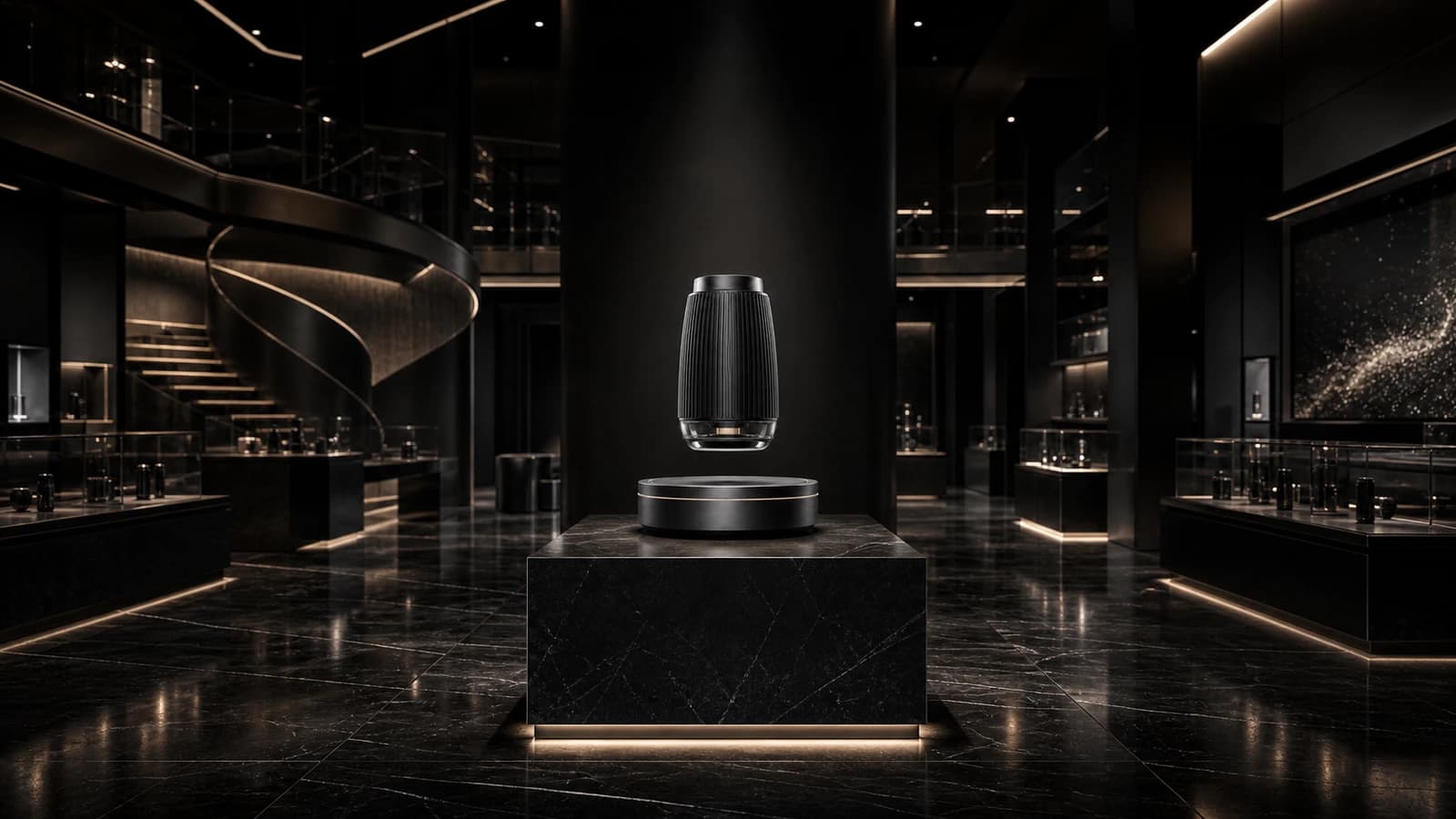
One of the clearest retail trends for attention-led merchandising is the rise of floating presentation. It combines technology, elegance, and memorability in a compact format. Brands like it because it offers a fresh visual language without the operational burden of a large scenographic build. It also works across multiple categories, from beauty and spirits to collectibles and design-led electronics.
Floating displays create premium contrast
A levitating object instantly distinguishes itself from adjacent product on shelves or tables. That contrast is crucial in stores where even good fixtures have become visually familiar. The effect is especially strong when the surrounding space remains calm and the display hardware stays materially refined.
Retail Trends 2026
Three broader trends are converging in 2026. First, brands are reducing display clutter and emphasizing hero storytelling. Second, they are seeking display systems that generate both physical attention and digital shareability. Third, they are looking for technology that can feel premium rather than loud. Magnetic levitation sits directly inside that intersection.
The store is becoming more editorial
Many successful retail environments now look more like galleries or studios than traditional selling floors. They present fewer products per focal zone but ask each product moment to work harder. That editorial shift favors display systems that isolate, frame, and dramatize one object without overwhelming the room.
Future Consumer Attention
The future of consumer attention in retail will belong to brands that can shape time, not only visibility. It is not enough to be seen. The product has to be inspected, remembered, and associated with a distinctive feeling. Display technologies that slow people down and create voluntary focus will therefore become more valuable.
Attention quality will outperform attention volume
More impressions do not automatically create better outcomes. A smaller number of high-quality in-store encounters can be more commercially meaningful than broader but shallower exposure. That is why display strategy is becoming part of brand strategy, not just store operations.
Conclusion
Retail display trends in 2026 point toward a simple conclusion: brands are looking for better ways to create attention without endlessly increasing advertising spend. Experience marketing, perceptual interaction, cleaner hero zones, and floating presentation are all responses to that challenge. Magnetic levitation matters in this context because it creates premium focus efficiently. It helps the store do what paid media alone cannot do: turn a physical encounter into a memorable event.
What This Means For Flagship Investment
For flagship stores, the shift toward attention-led display changes how brands evaluate capital spending. Instead of asking only how many products a fixture can hold, teams are asking how effectively it can frame the most important products, generate photographs, and support campaign storytelling. This favors investments that do more qualitative work per square meter. Levitation fits that requirement because it transforms a compact zone into a high-impact focal point.
Fewer but stronger moments are winning
Many brands are discovering that one sharply executed display moment can outperform a broader field of visually average fixtures. In premium environments, this is often the better economics. The store feels more intentional, the product gets more attention, and the installation has a higher chance of being remembered.
Metrics Retailers Should Watch
Retail teams can measure the success of attention-led display through several practical signals: dwell time near the focal zone, content capture frequency, staff engagement prompts, and uplift in hero-product conversation or conversion. Not every brand needs formal advanced analytics to learn from these displays. Even disciplined observational feedback from store teams can reveal which formats create stronger customer pause and inquiry.
Attention quality can be observed
If shoppers slow down, circle the display, ask questions, or photograph the product, the display is creating value beyond simple visibility. These behaviors are meaningful because they indicate that the environment is successfully earning attention rather than merely occupying space.
The Role Of Supplier Collaboration
Another trend for 2026 is that display suppliers are increasingly expected to contribute strategic thinking, not just fabrication. Brands want partners who understand why a display is being built, how it will be used, and what emotional effect it should create. Magnetic levitation projects benefit from this collaborative model because technical choices directly affect the experiential outcome.
Better collaboration produces better retail theater
When brand teams, designers, and manufacturers align early, the final installation feels more coherent. The display becomes part of the larger story of the store instead of an isolated special effect. That coherence is exactly what sophisticated retail environments are seeking.
Why Store Media And Display Need To Work Together
One important trend is the closer coordination between visual merchandising and brand media teams. A display now has to work not only for the shopper standing in front of it, but also for the phone camera, the campaign recap, and the social clip shared after launch. Floating presentation performs well here because it creates a clear subject with built-in drama while keeping the surrounding scene relatively clean.
Retail theater should be easy to capture
If the focal display photographs well, the store gains a second life online. That extends the value of the physical investment and helps the in-store experience support broader brand storytelling. In 2026, that overlap between physical and digital attention is becoming central to how brands assess display success.
Operational Simplicity Still Matters
Retail teams also want attention-driving displays that do not become complicated maintenance projects. The formats gaining traction are the ones that create premium effect while staying manageable for launch, reset, and store operation. Levitation gains strength here when it is engineered for quiet daily use and repeatable presentation quality.
Attention Has To Be Earned
The broader lesson for 2026 is simple: shoppers are increasingly selective with their focus. Brands that earn that focus through better physical staging will gain an advantage over brands that rely only on more media pressure. That is why display strategy is moving closer to the center of retail planning and becoming part of how leadership teams think about brand efficiency, campaign effectiveness, store productivity, and physical-brand differentiation in competitive retail districts and destination malls alike. The winners will treat display as a profit tool, not a styling exercise.
Contact AMO for OEM & ODM support.