
Introduction
Retail has always been a contest for space, but the most important space is no longer measured only in square meters. It is measured in seconds of concentrated human attention. A store can have a large footprint, expensive fixtures, and broad assortment, yet still underperform if customers never truly focus on what matters. This is why retail psychology is shifting. Merchandising success depends less on how much can be shown and more on how clearly attention can be directed.
For premium and design-led brands, this matters even more. Their products are rarely strongest when surrounded by visual competition. They perform best when the environment helps the customer slow down, isolate the object, and assign meaning to it.
Attention Economy
The phrase attention economy is often used in digital marketing, but it applies just as directly to physical retail. In-store attention is finite, selective, and expensive to waste. Customers enter with incomplete time, partial mental bandwidth, and many external comparisons already in mind. The retailer's job is to create enough clarity that one product moment can break through those competing inputs.
Attention is the precondition for value perception
If the product is not truly seen, its premium attributes cannot register properly. Material quality, craftsmanship, and subtle design choices all depend on focused observation. Retail teams that understand this stop optimizing only for display density and start optimizing for cognitive contrast.
Visual Competition
Many stores unintentionally create too much visual competition around their best products. Signage, product clustering, promotional graphics, and fixture repetition can all dilute the effect of the hero item. What is meant to create excitement sometimes creates blur instead. The eye keeps moving because nothing has been given enough authority to hold it.
More display elements can mean less actual seeing
This is one of the central paradoxes of retail presentation. Adding more visual information can lower the customer's ability to process what matters. Strong stores solve this by editing aggressively. They remove secondary noise so the primary object can gain gravity.
Product Focus
Product focus is not just about spotlighting. It is about designing a field where the product appears inevitable as the central subject. This includes spacing, light, backdrop, approach angle, and the visual weight of surrounding materials. A focused product moment can make the entire store feel more premium because it signals confidence in the object.
Focus changes decision quality
When customers can read the product clearly, they make better judgments about fit, value, and desirability. That improves not only immediate conversion but also post-purchase confidence. A display that helps the customer understand the object is often more powerful than one that simply creates noise around it.
Retail Psychology
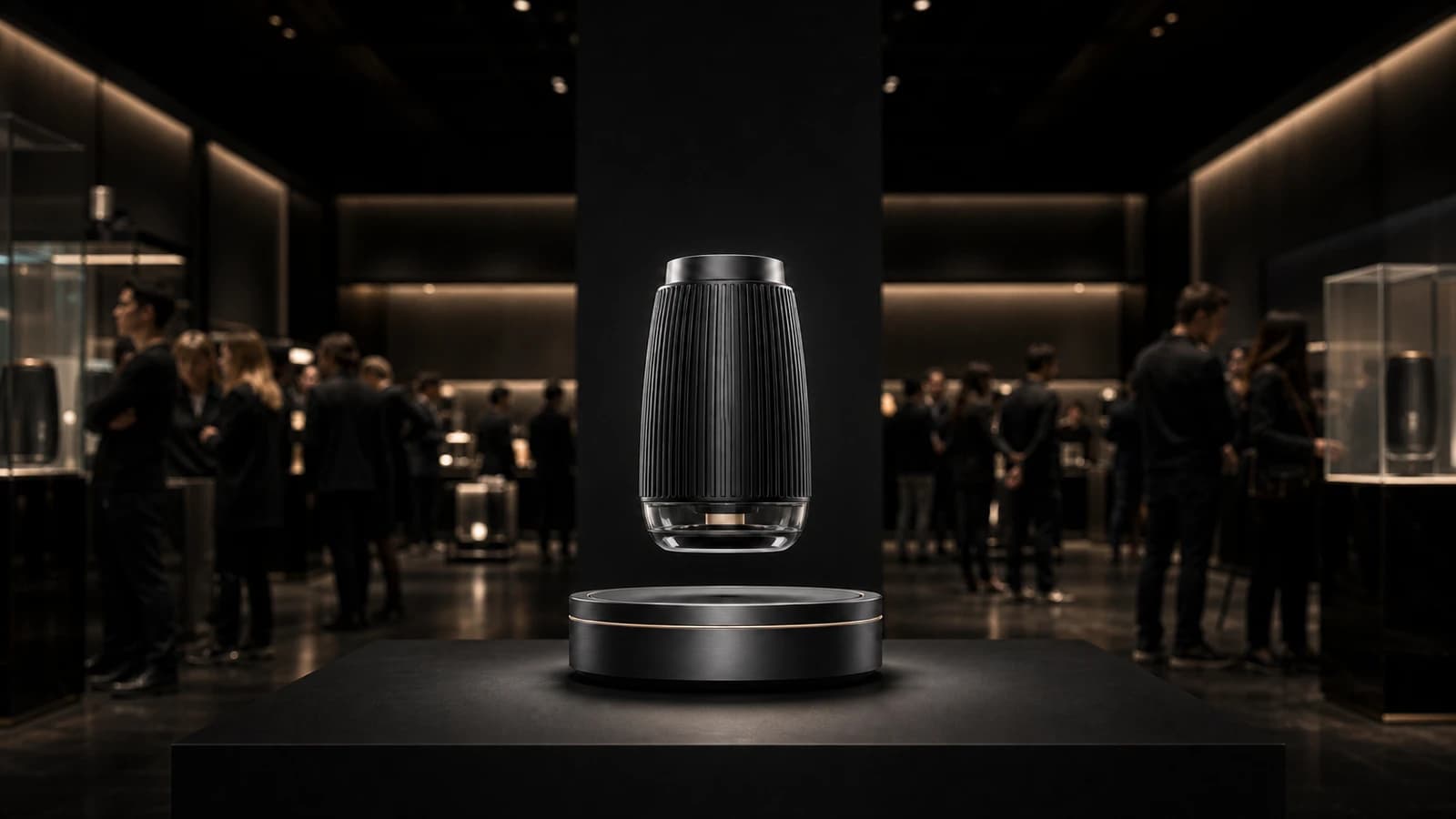
Retail psychology is heavily influenced by what feels easy to understand and worth approaching. A floating object can be powerful because it creates both distinction and curiosity with very little explanation. It invites the customer closer. The product becomes a question before it becomes a specification.
Curiosity is a high-value emotional trigger
Curiosity works well in retail because it is self-propelled. The customer chooses to engage rather than being pushed by overt messaging. That engagement is often deeper and more memorable. Displays that trigger curiosity are therefore especially useful for hero products, launches, and categories competing on premium perception.
Floating Displays
Floating displays create attention efficiently because they combine isolation, surprise, and elegance in one system. They do not require a crowded scenic build to create effect. The product simply appears more important because ordinary visual expectations have been interrupted. This is particularly effective in high-design retail environments where subtle differentiation is more valuable than loud intervention.
Floating presentation creates clean hierarchy
Hierarchy is everything in attention design. The floating product becomes the clear top priority in the field, while surrounding fixtures and merchandise fall into supporting roles. That clarity helps the shopper know where to look and how to interpret the scene.
Future Store Design
The future store will increasingly be judged by how intentionally it shapes attention. As brands become more selective about physical investment, they will prefer display systems that can turn one object into a memorable encounter. This will favor technologies and design strategies that create precision rather than volume.
Retail space must earn attention, not assume it
The store can no longer rely on presence alone. It must justify the customer's focus with a stronger sensory and emotional argument. Floating presentation is one of the tools that helps make that argument convincingly.
Conclusion
Attention is the most valuable space in retail because it is the gateway to perception, memory, and purchase confidence. Stores that understand this create cleaner hierarchies, reduce visual competition, and use focal displays to slow customers down around what matters most. Magnetic levitation fits that strategy because it turns one product into a concentrated moment of curiosity and focus. In a crowded retail landscape, that kind of attention is one of the few advantages that still compounds.
Measuring Attention In Store
Attention can feel intangible, but retailers can still evaluate it with practical discipline. Staff observations, dwell time near a focal display, content capture, repeat customer references, and changes in conversation around hero products all provide clues. The point is not to treat every display like a laboratory experiment. It is to recognize that attention quality can be observed and improved when stores pay close enough attention to behavior.
Observation sharpens merchandising decisions
When teams notice which displays consistently make customers slow down, point, ask questions, or photograph the product, they gain usable insight. That feedback can inform future store design, campaign investment, and supplier selection. In this sense, attention is not only a psychological concept. It is an operational one.
Designing Zones Around Human Focus
The strongest retail zones are built around how people actually look, pause, and approach, not just around fixture dimensions. This means considering sightline entry, competing light sources, distance between hero object and adjacent product, and how the shopper's body moves in relation to the display. Levitation works well because it naturally creates a center of gravity around which these decisions can be organized.
Focus should be designed, not hoped for
Too many retail spaces assume attention will happen automatically if the product is good enough. In reality, the environment has to make that attention easier. A well-designed focal zone removes friction from looking and makes the product feel worth approaching.
From Shelf Space To Mind Space
The real competitive advantage in modern retail is not just owning shelf space. It is owning mind space. That means building product encounters strong enough to survive after the customer leaves the store. Displays that create sharp visual memory have more strategic value than displays that merely hold inventory.
Mind space compounds
Once a product encounter is remembered, it continues influencing later search, conversation, and comparison. This is why attention is the most valuable space in retail. It is the space where premium perception begins and where future buying decisions quietly take shape.
Attention Design Benefits From Simplicity
The more important attention becomes, the more valuable simplicity becomes as a retail design tool. Simplicity does not mean emptiness for its own sake. It means removing enough noise that the customer's eye can make a clean decision about what deserves focus. In premium retail, this often creates stronger results than adding more campaign surfaces or promotional interference around the hero product.
Simplicity creates confidence
When a store presents one object with strong hierarchy and calm framing, it communicates confidence. The customer reads that confidence quickly. The product appears worthy of space, and the brand appears certain of its importance. That psychological effect is one reason edited environments often feel more luxurious.
From Seeing To Remembering
Attention is valuable because it is the first step in a longer chain. Once the customer truly sees the product, they can evaluate it. Once they evaluate it, they may remember it. Once they remember it, the brand has a chance to influence later behavior outside the store. Displays that improve this chain are not decorative extras. They are strategic assets in how retail space performs.
Focus Creates Commercial Leverage
When a retailer can reliably create focus around its most important objects, every other part of the commercial system becomes more effective. Staff conversations improve, product memory improves, and the store begins doing more persuasive work on behalf of the brand. That is why attention deserves to be treated as a strategic design resource.
Leverage comes from consistency
The most effective stores create this focused experience repeatedly, not only during launch week. Consistent attention design is what turns a strong display tactic into a long-term retail advantage, a repeatable merchandising discipline, and a better use of physical capital across the network and across future campaigns over time. It also supports stronger staff storytelling.
Call To Action
Looking for a custom magnetic levitation project?
Contact AMO for OEM & ODM support.