
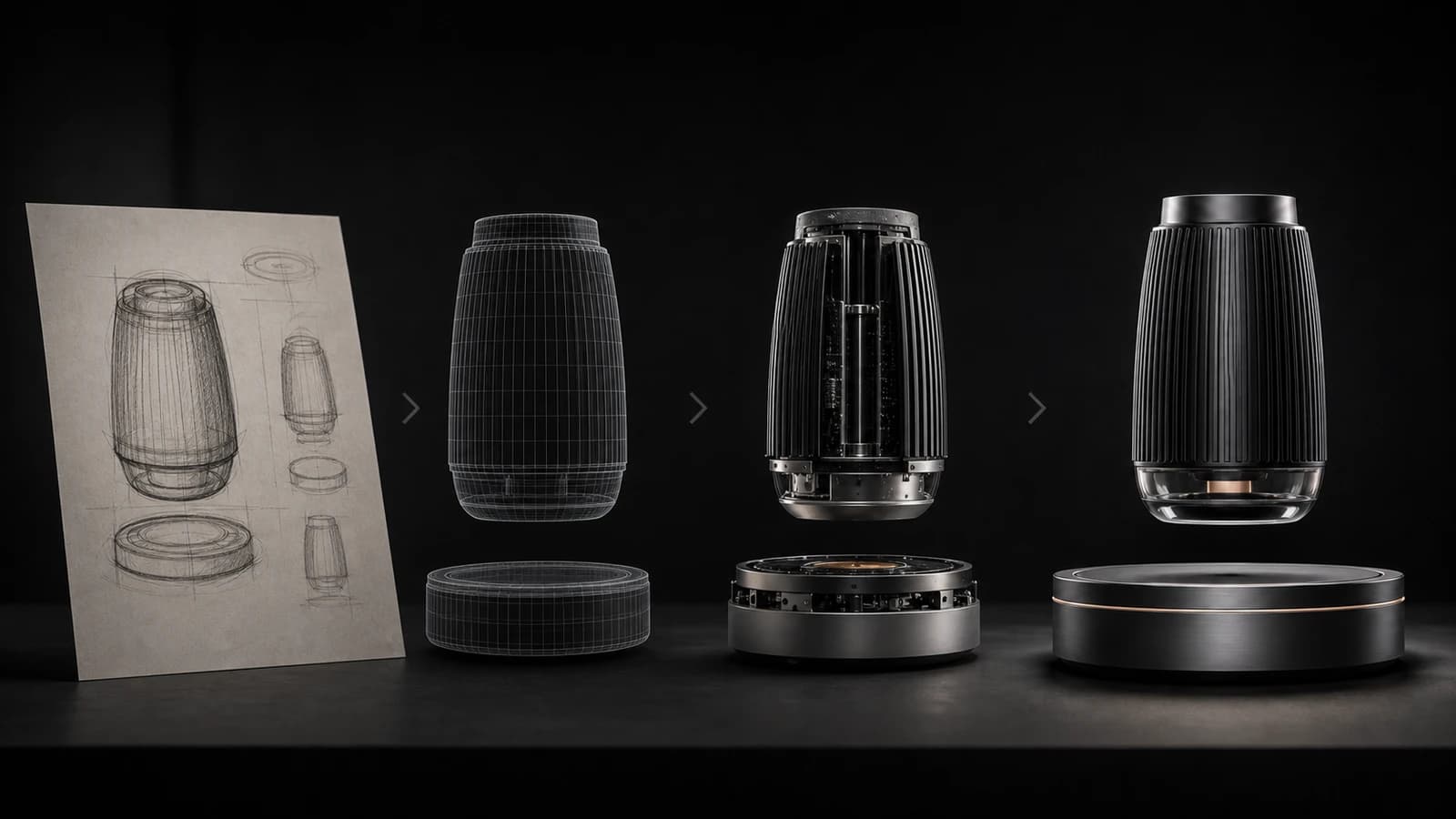
Introduction
If you are sourcing OEM magnetic levitation products, the first procurement step is not price. It is a usable design brief covering the object type, operating environment, target quantity, approval path, and launch timing. That information lets the manufacturer judge feasibility, MOQ, and customization scope through the right OEM & ODM workflow and against the most relevant reference options in the product collection.
The next question is how prototype validation, sampling, and mass production will be staged. Buyers should ask when a working sample will be reviewed, who signs off on revisions, how lead time changes after engineering updates, and what has to be approved before production starts. A structured RFQ reduces ambiguity around quantities, branding, and delivery windows before development cost begins to rise.
That is why the route from concept to production needs structure. When the workflow is fragmented, teams waste time solving the same problem multiple times in different formats. When the workflow is integrated, the project moves with fewer surprises and stronger commercial confidence.
Project Brief
The project brief is where the commercial objective becomes an engineering target. A good brief defines more than the desired appearance of the floating object. It clarifies payload size, intended environment, visual tone, rotation expectations, packaging requirements, certification needs, budget range, and delivery timing. The most successful OEM programs also identify who will approve what: design, brand, procurement, and technical stakeholders each judge the project by different criteria.
A strong brief prevents expensive loops
If a supplier receives only mood images and a target price, the project often enters a trial-and-error cycle. A structured brief reduces that loop by giving the manufacturer enough context to propose the right levitation module, product envelope, and development path from the start. In other words, clarity early usually saves both money and calendar time later.
Concept Design
Concept design translates the brief into visible directions. This stage may involve silhouette studies, base proportions, finish options, lighting ideas, and product-to-base relationships. For levitation products, concept design must also consider how the object will visually behave when floating. A form that looks balanced on paper may feel unstable in space if the mass distribution or center of gravity is not considered.
Design has to anticipate engineering
The strongest OEM partners do not separate concept styling from functional logic. They evaluate whether the object can maintain the desired visual purity while still leaving enough room for the magnetic architecture to work. That prevents late-stage compromises where the product has to become bulkier, heavier, or less elegant than the original design promised.
Engineering
Engineering is where the product stops being an image and becomes a system. The team needs to define payload tolerance, base electronics, magnet arrangement, power input, thermal considerations, and the relationship between object geometry and hovering behavior. Engineering also includes decisions about assembly method, material feasibility, and how the product will be protected during transport.
Engineering makes luxury believable
Premium display products often look simple on the outside, but simplicity is achieved through disciplined hidden complexity. Quiet operation, stable hovering, and smooth rotation do not happen by chance. They come from engineering choices that remove friction from the user experience. Buyers should expect this stage to include real tradeoff discussions, not just optimistic assurances.
Prototype
The first prototype is the moment when assumptions become visible. It reveals whether the object feels correctly proportioned in space, whether the hovering distance looks credible, whether motion is elegant, and whether the finish concept still works under real lighting. In levitation projects, prototypes are especially valuable because small changes in weight or geometry can materially affect behavior.
The prototype should answer specific questions
A useful prototype is not only for admiration. It should test known risks. Is the product easy to align? Does the base feel premium enough? Does the rotation speed match the brand intent? Are the materials robust enough for handling? Teams that approach prototyping with clear questions get far more value than teams that treat it as a ceremonial milestone.
Sampling
Sampling refines the prototype into something closer to production reality. This stage often includes color confirmation, packaging trials, instruction review, accessory fit, and final surface adjustments. It is also where tolerance issues, charging details, adapter requirements, and carton protection need to be settled. For global programs, sampling is the stage where compliance and shipping assumptions should be checked carefully.
Sample approval should be disciplined
When sample feedback is loose or fragmented, the project absorbs hidden change requests that later slow production. It helps to collect design, technical, and commercial comments into one consolidated approval cycle. That gives the manufacturer a clean instruction set and reduces the risk of contradictory revisions.
Mass Production
Mass production is where many visually successful projects either prove their maturity or reveal their weaknesses. The supplier must maintain stable levitation performance while repeating cosmetic quality across the production batch. Assembly sequencing, incoming material control, functional testing, and packaging consistency become critical. A product that works beautifully in one hand-built sample may still fail commercially if the process cannot repeat it at scale.
Production discipline protects the brand
In premium categories, cosmetic inconsistency is just as damaging as functional inconsistency. Scratches, color drift, uneven lighting, or unstable floating behavior can all undermine the intended market position. That is why production planning should include both performance inspection and finish inspection, not one at the expense of the other.
Global Delivery
The project is not complete when production finishes. International delivery introduces voltage requirements, carton protection, customs documentation, shipping mode decisions, and warehouse handling risks. Levitation products are especially sensitive because the brand promise depends on the unit arriving in stable, undamaged condition and being easy to set up at destination.
Packaging is part of product performance
For OEM programs, packaging is not a separate afterthought. It is an extension of the product system. The best suppliers design packaging to protect both hardware and premium presentation, while also accounting for retailer handling, gifting presentation, or installation-team workflow. Good packaging reduces claims, accelerates deployment, and reinforces perceived value.
Conclusion
OEM magnetic levitation products move successfully from concept to production when every stage answers the next stage's questions instead of creating new ambiguity. A disciplined brief, design-development loop, engineering review, prototype test, sample approval, production control, and delivery plan turn a visual idea into a dependable commercial product. That process is what separates a one-off floating object from a scalable, brand-ready levitation program.
Cross-Functional Communication
One of the most underestimated parts of OEM development is cross-functional communication. Brand teams, industrial designers, procurement managers, and technical reviewers often evaluate the same sample through different priorities. One group is focused on visual refinement, another on cost, another on schedule, and another on reliability. If those perspectives are not gathered and reconciled early, the project absorbs conflicting requests that slow progress and weaken decision quality.
Structured reviews keep development efficient
The most efficient programs create scheduled review points where all major stakeholders respond to the same prototype or sample at the same time. That prevents feedback from arriving in fragments. It also helps the manufacturer understand which changes are mandatory, which are optional, and which would compromise other parts of the product. In practice, that discipline saves more time than most buyers expect.
Cost Control Without Weakening The Product
Cost control is a normal part of OEM development, but it works best when it is handled deliberately rather than reactively. Trying to force cost reduction too late often results in cosmetic downgrade, weaker packaging, or compromised motion quality. A better approach is to discuss cost structure earlier: base architecture, materials, packaging choices, accessory count, and finish complexity all affect the final number.
Value engineering should protect the experience
Good value engineering is not about making the product cheaper in a superficial sense. It is about protecting the experience that matters most while simplifying what the end user will barely notice. When handled well, this can improve the product by sharpening focus. When handled poorly, it creates a sample that still looks acceptable but no longer feels premium in use.
Launch Readiness
Before mass rollout, the project should be reviewed as a complete commercial system. That includes the levitation performance, the visual presentation, the package protection, the unboxing sequence, the power configuration, and the installation instructions. A launch can fail even when the product itself is strong if the receiving teams do not know how to deploy it consistently.
Readiness is operational, not just visual
The strongest OEM partners think beyond the sample room. They consider how the product will be unpacked in a flagship store, received by a gifting client, or installed in an exhibition environment. That practical perspective is what turns a successful prototype into a successful launch.
Managing Final Approvals
OEM projects often slow down at the final approval stage, not because the product is weak, but because teams have not clearly defined who signs off on which part of the result. Visual approval, packaging approval, and functional approval should be coordinated instead of scattered across separate threads. A disciplined sign-off process protects both the launch date and the integrity of the final specification.
Approval clarity shortens the last mile
When every stakeholder knows the decision criteria in advance, the project can move from sample to production with far less friction. That last-mile efficiency is one of the biggest advantages of a mature OEM workflow.
Contact AMO for OEM & ODM support.
Buyer FAQ
What should an OEM magnetic levitation design brief include?
A usable brief should define the product type, target application, size, quantity, branding scope, operating environment, and launch timing. That gives the OEM & ODM page enough context to frame feasibility against the current product range.
How should prototype validation be handled?
Prototype validation should happen before packaging approval or mass-production planning. Buyers usually check levitation stability, finish quality, sound level, rotation behavior, and visible presentation, then use the RFQ page to document revision scope and schedule impact.
When should sampling and mass production begin?
Sampling should begin after the working prototype is approved and the commercial assumptions are clear. Mass production should wait until quantity, MOQ, lead time, packaging, and delivery timing are aligned through the RFQ process or direct project discussion.