
Direct Answer
There is no single price for a custom magnetic levitation display because the cost depends on whether the project adapts a standard platform or develops a new object, enclosure, lighting system, package, and production process. The largest cost drivers are payload and stability requirements, industrial design, prototypes, custom materials and finishes, tooling, electronics, testing, packaging, quantity, delivery market, and schedule.
A credible supplier should not quote a complex project from one reference image alone. To build a useful budget, provide the object's dimensions and weight, intended environment, desired appearance, quantity range, packaging level, destination, and target date. The supplier can then separate development cost, sample cost, unit cost, tooling, and logistics.
Standard Platform Versus New Engineering
The most economical custom route often uses a proven levitation module inside a new visual enclosure. Engineering work still remains, but the magnetic architecture starts from known behavior. If the payload, air gap, shape, or operating environment sits outside existing capability, the project may need a different module or deeper system development.
This distinction matters because cosmetic customization and technical customization carry different risk. Changing color, surface material, logo treatment, or package around a validated platform is usually more predictable than increasing load, changing magnetic geometry, or adding power transfer to the floating object.
Design, Prototype, and Sample Cost
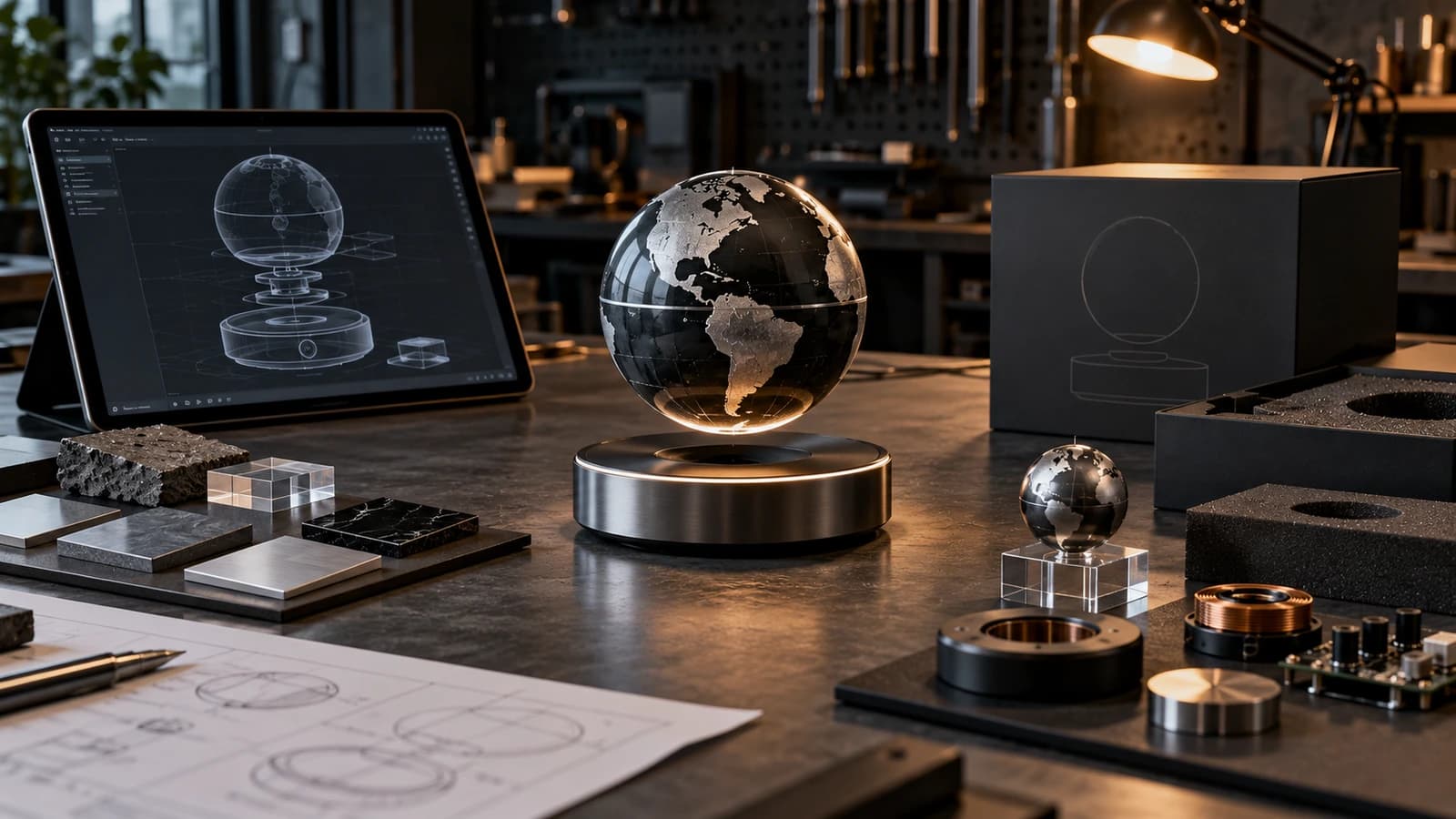
Concept design defines the object, base proportions, materials, light, and brand relationship. Engineering then checks whether that design can balance, operate, assemble, and ship. A prototype tests the highest-risk assumptions, while a production-intent sample confirms finish, packaging, instructions, power, and repeatability.
Each revision consumes time and material, so clear approvals reduce cost. If brand, engineering, and procurement give separate late feedback, the project may repeat work. A consolidated brief and one decision owner make the process more efficient without removing necessary testing.
Materials, Finish, Lighting, and Packaging
Material choices affect both appearance and manufacturing method. A painted polymer shell, machined metal enclosure, wood surface, glass-like element, or mixed-material object each brings different tooling, tolerance, weight, and quality-control needs. Premium finishes often require more sample review because color, gloss, texture, edge quality, and fingerprints become visible in the final environment.
Lighting adds components, heat, wiring, optics, and assembly. Packaging must protect magnets, surfaces, electronics, and the floating object while also guiding the first setup. Gift packaging, retail packaging, and reusable transport cases solve different problems and should be budgeted separately.
Quantity and Unit Economics
Low quantities usually carry a higher unit cost because development, setup, tooling, and inspection are spread across fewer pieces. Higher quantities can improve unit economics, but they also increase the importance of process control and may require more robust tooling or packaging validation. The lowest quoted unit price is not always the lowest project cost if it excludes samples, rejects, spare units, or destination requirements.
Ask for price breaks at realistic quantity ranges instead of one optimistic forecast. Also confirm what is included: adapter, floating object, base, packaging, instructions, branding, inspection, and freight may be quoted separately. The MOQ, sampling, and lead-time guide provides a useful framework for comparing offers.
Timeline, Testing, and Delivery Risk
Urgent schedules can increase cost when design, sampling, and production overlap or require expedited materials and freight. Cutting sample review may appear cheaper but can move risk into production. A better approach is to identify which decisions are fixed, which can use standard components, and which tests are essential for the operating environment.
Delivery market can influence plug type, documentation, packaging marks, freight method, and compliance work. Requirements should be confirmed for the actual product and destination; do not assume a generic certificate or claim applies. Budget for spare units, replacement adapters, and installation support when a launch date or multi-store rollout cannot tolerate downtime.
Ask every quotation to state its assumptions and exclusions. A useful proposal identifies what will be tested, how many revisions are included, which party supplies design files, when tooling becomes committed, and whether freight and taxes are excluded. Without those boundaries, two prices that look comparable may describe very different deliverables. Budget decisions are stronger when technical scope and commercial scope are reviewed together.
Decision Checklist
Build a budget from these line items:
- Feasibility review and platform selection.
- Industrial design, engineering, CAD, and prototype work.
- Magnetic module, electronics, lighting, and power supply.
- Object and base materials, finishes, tooling, and assembly.
- Sample rounds, functional testing, and cosmetic approval.
- Retail, gift, or transport packaging and instructions.
- Unit quantity, inspection standard, spares, and warranty support.
- Freight, destination requirements, installation, and schedule contingency.
Compare every supplier quote against the same scope so missing items do not look like savings.
FAQ
Is a custom magnetic levitation display expensive?
It can be, especially when it requires new engineering, premium materials, multiple samples, tooling, or a small quantity. Adapting a proven platform can reduce cost and risk.
Can I get a price from a picture?
A picture supports visual discussion but not a reliable quote. Suppliers need dimensions, weight, quantity, materials, operation, packaging, destination, and timing.
What is usually paid before mass production?
Projects may include design, engineering, prototype, sample, and tooling charges before production. Commercial terms vary, so ask for a staged cost breakdown.
Does a higher quantity always reduce the total budget?
It can lower unit cost, but total spend increases and the project may need stronger tooling, inspection, logistics, and spare planning. Evaluate total program cost.
How can I reduce cost without weakening the display?
Use a proven module, keep payload within a comfortable range, limit custom materials, consolidate revisions, approve one production-intent sample, and plan a realistic schedule.
Next Step
Prepare a brief with object data, use environment, quantity range, finish references, packaging level, destination, budget range, and launch date. AMO's OEM and ODM process connects concept, engineering, sample, and production. Submit the complete project brief through request a quote to receive a scoped response rather than an unsupported headline price.